At the end of this summer, I decided it was time to upgrade my road bike.
Context: I’m not a competitive cyclist, I’m an enthusiast who enjoys 15-30 mile Saturday morning rides. I don’t need brand new or the latest tech.
My 2012 Fuji Roubaix 3.0 has served me well. It’s an aluminum bike with a carbon fork and Shimano Sora components—reliable, comfortable, and still perfectly rideable. But I wanted my next bike to feel like a meaningful upgrade: carbon frame, substantially better components, lighter weight, and something I could happily ride for many years.
I also had a theory about the market. Late summer means end-of-season sales, and those discounts put pressure on used-bike prices. Meanwhile, the industry’s move toward disc brakes has made some extremely good rim-brake race bikes surprisingly affordable.
I set a budget around $1,400 and decided to see how much bike I could get.
And I brought ChatGPT along as my buying assistant.
The interesting part wasn’t simply asking AI, “What bike should I buy?” Instead, I used it to make a complicated secondhand market much easier to navigate.
I established my parameters: I’m 5’11”, normally ride a 56 cm frame, wanted carbon, preferred Shimano 105 or better, and cared more about getting a great bike than getting the newest model year. Then I started feeding it eBay listings.
That’s where AI became genuinely useful.
A used-bike listing might say “Giant TCR Advanced Pro,” but that alone doesn’t tell you much. Which generation? What was its original build? Are those the original wheels? How does that frame compare with a similarly priced Specialized Tarmac? Is $1,700 reasonable or is $1,350 closer to the market value?
Instead of opening fifteen browser tabs every time I found a bike, I could have ChatGPT research the model, decode its components, compare it with other candidates, identify things that looked unusual in the listing, and help establish a rational price range.
We (yes, myself + ChatGPT is ‘we’) went through Giant TCRs, Specialized Tarmacs and Roubaix models, and several others. Some candidates became more interesting after research. Others became less interesting. One listing was just incomplete enough to make me uncomfortable. Another turned out to have a different wheelset than I initially believed.
The AI wasn’t making the decision. It was making me a better-informed buyer.
It was especially helpful when bidding started. Rather than treating an eBay auction like a competition to win, we(!) worked backward from the bike’s value. What would be a great price? What was reasonable? At what point should I simply walk away?
Eventually a 2018 Felt FR1 appeared: 56 cm carbon frame, Dura-Ace drivetrain, a Pioneer power meter, and a very reasonable opening bid (or reserve price).
When new, the FR1 was a genuinely high-end race bike. Eight years later, rim brakes and depreciation had put it within my budget.
I placed the bid.
And then…nothing happened.
No bidding war. No last-second escalation. I was the only bidder.
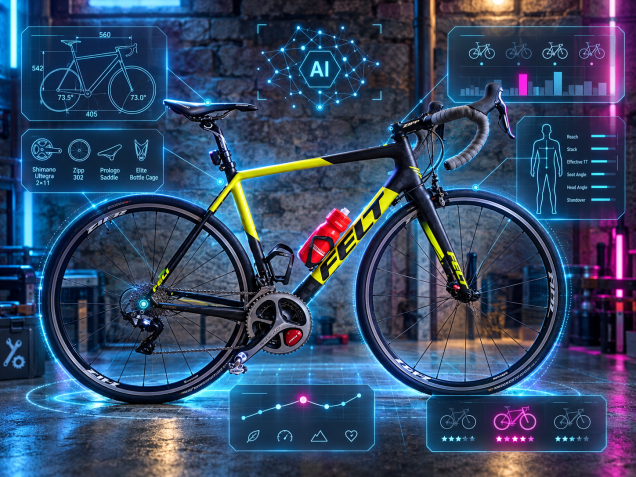
AI’s role didn’t end with the auction. When a partially disassembled carbon race bike arrived in a giant cardboard box, ChatGPT transitioned from buying assistant to interactive service manual.
I used it while reinstalling the fork and handlebars, reconnecting brakes, troubleshooting the front derailleur, checking torque requirements and figuring out which maintenance items actually needed attention. We researched tire clearance and the wheels that were actually installed on the bike. I ordered 28 mm tires, tubes, tools and supplies. When the existing 120 mm stem felt a little long, we worked through what changing to 90 mm would actually do to the fit.
There’s something particularly useful about AI in this kind of project. Traditional search is great when you know exactly what question you’re asking. But projects generate chains of tiny, contextual questions: What is this part? Is this normal? Does this component fit this particular frame? The seller said this—what does that imply? Here’s another listing; is it better than yesterday’s?
AI can maintain that context as the project evolves.
And then, eventually, the research ends.
After a two-mile systems check, I took the Felt out for a proper 15-mile shakedown ride.
It was fantastic.
Fast, light, responsive and just tremendously fun to ride. There are still some small fit adjustments to make, but it already feels like the meaningful upgrade I was looking for.
AI didn’t buy me a bike. It didn’t inspect the carbon, turn the wrench, place the bid, or pedal those first 15 miles.
But it dramatically lowered the cost (in time and effort) of becoming an informed buyer.
Now having ridden this new (to me) Felt and had an awesome experience, I’d call that a pretty good result.

